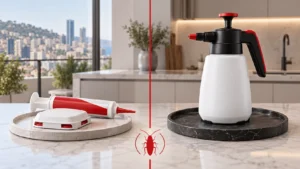
You bought the blue pellets from the shop downstairs. You put them behind the fridge and under the sink, exactly where you hear the noise at night. A week later the bait is gone and nothing else has changed. The scratching in the ceiling is still there.
If that sounds like your building, you are not doing it wrong. Rat poison not working in Lebanon has a documented biological reason behind it, and it was measured on Lebanese animals.
This article explains what the research found, why an anticoagulant bait can be eaten happily and change nothing, and what a professional programme does differently in a Lebanese building.
What the Lebanese research actually found
A 2022 study in Scientific Reports found Vkorc1 mutations associated with anticoagulant resistance in 14 of the 24 house mice sequenced, or 58.3%. This is a finding from the sampled animals, not a national prevalence estimate or proof of resistance in your building. Read the original Lebanese rodent study. Species identification, bait placement, food and entry points still need assessment.
The study supports considering resistance when a control programme does not reduce activity. It does not establish why a particular bait has failed at a particular property, and house-mouse findings should not be generalised to every rat infestation.
All three commensal rodent species are present in Lebanon, so a building can easily be dealing with more than one problem at once, each behaving differently.
How anticoagulant bait is supposed to work
Anticoagulant baits interrupt the vitamin K cycle, which the body needs to clot blood. The rodent eats over several feedings, clotting fails, and the animal dies days later. The delay is deliberate, because rodents avoid food that makes them ill quickly.
Vkorc1 encodes an enzyme involved in vitamin K recycling. Certain changes can reduce sensitivity to particular anticoagulants. The effect depends on the mutation and active ingredient, so continued bait consumption alone does not diagnose resistance.
The three other reasons shop-bought bait fails
Resistance is the reason nobody talks about. There are three more that are just as common in Lebanese buildings, and they matter even where the rodents are fully susceptible.
There is better food available
A bait block competes with whatever else is on offer. When collection on the street has been suspended and bags are sitting at the corner, or when a bin room in the basement is not sealed, the bait is the least interesting meal in the building. Our rodent control work in Lebanon is planned around the waste cycle, because collection suspensions in Beirut, Metn and Keserwan come back around.
The bait is in the wrong place
Rats move along walls and edges and dislike open floor. Bait placed in the middle of a room or in a spot that feels exposed is often simply never visited. Placement follows droppings, smear marks along skirting and pipework, gnaw damage and the routes between the food source and the harbourage.
Nothing was closed behind them
A building that keeps its gaps keeps its rodents. Mice pass through openings far smaller than people expect, and service risers, drainage stacks, door sweeps and the gaps around pipe penetrations are the usual routes. Killing the current population without closing the route only buys time until the next one arrives.
What changes in a professional programme
- Identify what you actually have. Rats and mice leave different droppings, different smear patterns and different damage, and they need different placements.
- Map the route, not just the sighting. Where they enter, where they nest, and what they are eating.
- Use monitoring before saturation. Non-toxic monitoring blocks and tracking show where the activity really is, so control is placed rather than scattered.
- Change the approach when the evidence says so. Where bait is being eaten with no drop in activity, trapping and exclusion carry the work instead of a heavier dose of the same thing.
- Close the building. Sealing and proofing is what makes the result last past the season.
- Secure the bins. Lidded containers, a clean bin room and a plan for the weeks when collection stops.
A safety point worth stating plainly
Loose pellets scattered on the floor of a shared building are a risk to children and to pets, and they are also the least effective way to place a rodenticide. Bait belongs in a secured station, positioned where a person cannot reach into it, and it should be logged so that whoever placed it can come back and remove what is left.
If anyone treats your building, ask what was placed, where, and who is coming back for it. That question is reasonable in any building, and it is the same question that matters after Lebanon banned aluminium and zinc phosphide for pest control in residential and populated areas, which is covered in our guide to checking that a pest control company is licensed.
Still hearing them at night?
Tell us what you are seeing and where in the building. The inspection is free.
Frequently asked questions
Why is my rat poison not working in Lebanon?
A 2022 study in Scientific Reports found Vkorc1 mutations associated with anticoagulant resistance in 14 of the 24 house mice sequenced, or 58.3%. This is a finding from the sampled animals, not a national prevalence estimate or proof of resistance in your building. Read the original Lebanese rodent study. Species identification, bait placement, food and entry points still need assessment.
What is Vkorc1?
It is the gene that anticoagulant rodenticides act on. Certain mutations in it reduce how well the poison binds, so the animal can keep feeding with far less effect.
Should I just use more rat poison?
No. Where bait is being eaten without any drop in activity, more of the same product is unlikely to change the outcome and adds risk for children and pets. The method needs to change, not the quantity.
Do traps work better than bait?
In a resistant population, or anywhere a dead rodent inside a wall would be a problem, trapping gives you a result you can see and remove. It works best combined with sealing entry points.
Why do rodents get worse when rubbish is not collected?
Uncollected waste is a reliable food supply on the street, which supports a larger population and makes any bait far less attractive by comparison. Collection suspensions in Beirut, Metn and Keserwan recur, so rodent work is planned around that calendar.
How long does a rodent control programme take?
It depends on the size of the building, how many entry points there are and whether the food source can be removed. Expect an inspection, treatment, and at least one follow-up visit to confirm the activity has stopped.
Is rodent bait safe around children and pets?
Loose pellets on an open floor are not. Bait should sit in a secured station placed out of reach, be recorded, and be collected again by whoever placed it.
Can rodents come back after treatment?
Yes, if the entry points stay open and the food source stays available. Sealing the building and securing the bins is what makes the result hold.